Car Maintenance Classes for Young Adults: A How-To Guide
Table of Contents
Why Car Maintenance Classes Matter for New Drivers
What You'll Learn in Basic Car Maintenance Classes
1. Reading Your Owner's Manual and Maintenance Schedule
2. Fluid Checks and Changes
3. Tire Care: Pressure, Tread, and Rotation
4. Battery Basics
5. Brake System Inspection
6. Safety and Emergency Preparedness
7. Building a Maintenance Log
Hands-On Car Care Workshop Structure and Format
Car Maintenance for Beginners: Finding Local Classes
The Four Provider Types (and What Each Is Actually Good For)
How to Evaluate an Instructor Before You Pay
Realistic Cost Ranges
Finding Free and Low-Cost Options
Scheduling Around Work and School
Basic Vehicle Maintenance Lessons: What to Expect
Building Confidence Beyond the Classroom
Common Mistakes New Drivers Make with Vehicle Care
Getting Started: Next Steps
Frequently Asked Questions
Last Updated: October 5, 2026
Why Car Maintenance Classes Matter for New Drivers
Most new drivers focus on passing their test and skip keeping their vehicle running safely. That's where the real problems start.
Waiting costs money and creates risk, a flat tire at night isn't the time to learn how to change it.
Car maintenance classes bridge the gap between passing your driving test and becoming a truly independent driver, teaching skills YouTube videos can't fully demonstrate.
What You'll Learn in Basic Car Maintenance Classes
A solid beginner class is built around a specific, finite curriculum, not a tour of everything under the hood. The goal: you leave able to perform a defined set of tasks safely, on your own car, with basic tools.
1. Reading Your Owner's Manual and Maintenance Schedule
This is the first thing a good instructor covers, and the one most new drivers skip. Your owner's manual contains the manufacturer's maintenance schedule, the specific intervals for oil changes, tire rotations, fluid flushes, and inspections for your vehicle.
You will learn to find the schedule, identify which interval applies to your driving, and build a simple log from it, preventing the most expensive mistake new owners make: assuming maintenance is the same for every car.
2. Fluid Checks and Changes
Your vehicle depends on several fluids, each with its own check method and interval.
Engine oil. Check with the dipstick on a level surface with the engine off and cool, reading the level against the marks and assessing color and consistency. A full oil and filter change is the classic first hands-on task.
Coolant. Check the reservoir when the engine is cold, never open a hot radiator cap. Learn the warning signs of a failing cooling system, such as a sweet smell or a low reservoir with no visible leak.
Brake fluid. Check the level in the master cylinder reservoir and note the color. Dark fluid can indicate it is due for a flush.
A basic class teaches you to inspect all of these monthly and to recognize when a level is dropping abnormally, which usually signals a leak.
3. Tire Care: Pressure, Tread, and Rotation
Your tires are the only part of the car touching the road, and the easiest thing to maintain yourself.
Pressure. Check monthly with a gauge when tires are cold. The correct pressure is on the driver's-side door jamb sticker, not the number molded into the sidewall, that is the maximum, not the recommendation.
Tread depth. The penny test is the quick check: insert a penny with Lincoln's head upside down; if you see the top of his head, the tread is worn. Most states set the legal minimum at 2/32 of an inch, but many technicians recommend replacing at 4/32.
Rotation. Most vehicles need rotation every 5,000 to 7,000 miles, or per the manual. You will learn to safely lift the car with a jack and jack stands, remove the wheels, and rotate them in the correct pattern for your drivetrain.
Proper tire maintenance improves fuel economy, extends tire life, and is the single biggest factor in wet-weather safety.
4. Battery Basics
Batteries fail predictably, and the warning signs are learnable: inspect terminals for corrosion, check that connections are tight, and watch for slow cranking, dim lights at idle, or a battery more than three to four years old. Many classes also demonstrate how to safely jump-start a car without damaging either vehicle's electronics.
5. Brake System Inspection
Brakes are non-negotiable for safety. You will learn to spot wear before it becomes a failure.
Brake pads sit against rotors and create the friction that stops the car. Squealing, grinding, or a soft pedal are the classic warning signs of wear.
Rotors are the metal discs the pads clamp onto, and they can warp or groove over time. A basic inspection teaches you to spot damage visually and by feel, and when pads alone will do versus when rotors need work.
A class will show you how to remove a wheel and inspect pad thickness, catching a $150 pad job before it becomes a $600 rotor-and-pad job.
6. Safety and Emergency Preparedness
This is the part most self-taught drivers never get, and where a class earns its price.
Changing a tire on the roadside. Practice the full sequence: pulling safely off the road, setting the parking brake, loosening lug nuts before lifting, placing jack stands, and torquing the nuts in a star pattern.
Jump-starting safely. Correct cable order, why you connect negative to bare metal on the dead car rather than the battery terminal, and when to call for help instead.
What to keep in the car. A basic kit, jack, lug wrench, spare or inflator, jumper cables, flashlight, gloves, and reflective triangles or flares.
Key Takeaway A good beginner class leaves you with three things: a maintenance schedule built from your own owner's manual, a short list of tasks you can perform safely, and a clear sense of what to leave to a professional.
7. Building a Maintenance Log
Finally, you will learn to keep records, date, mileage, and what was done. This log protects your warranty, raises resale value, and helps any mechanic diagnose problems faster. It is the least glamorous skill in the class and one of the most valuable.
Hands-On Car Care Workshop Structure and Format
The best car maintenance classes combine classroom instruction with real work on real vehicles. You don't just watch a video.
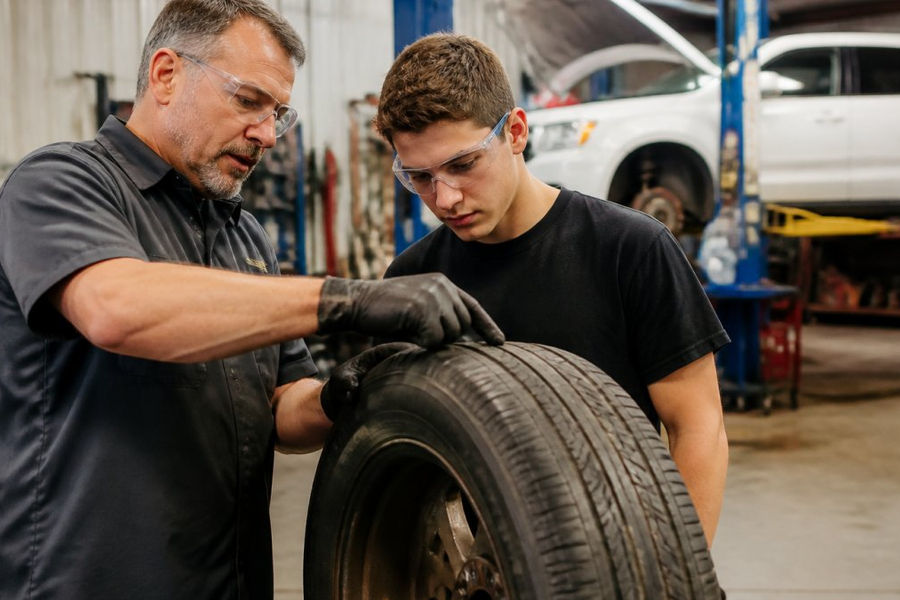
A typical workshop starts with safety: proper tool use, how to safely lift a car, and what protective equipment you need.
The instructors matter enormously. Master Technicians and Field Service Engineers bring real-world experience, explaining not just how to do something but why it matters.
Car Maintenance for Beginners: Finding Local Classes
Finding the right class starts with knowing that "car maintenance class" describes at least four very different things.
The Four Provider Types (and What Each Is Actually Good For)
**1.
2. Adult-education and parks-and-recreation workshops. Cities, school districts, and community centers frequently run one-night "basic car care" or "know your car" workshops, cheap, short (usually 2-3 hours), and beginner-friendly.
3. Dealership and independent-shop clinics. Many service departments host free or low-cost Saturday clinics for new owners.
4. Online courses and video series. Useful for theory and reviewing a procedure before you attempt it, but they cannot replace supervised hands-on practice.
How to Evaluate an Instructor Before You Pay
Ask these questions directly. A good program will answer them without hesitation.
Is the instructor ASE-certified? The National Institute for Automotive Service Excellence (ASE) is the standard credential for U.S. technicians. Not required to teach, but a useful signal.
What is the student-to-instructor ratio? For hands-on work, anything above roughly 8:1 means you'll spend most of the class watching.
Do students work on real vehicles, or on trainers and mock-ups? If the answer is "trainers only," you are paying for a demonstration, not practice.
Pro Tip Before you enroll, call the program and ask to speak to one past student. Most will happily connect you. One five-minute conversation tells you more than any brochure.
Realistic Cost Ranges
Pricing varies widely by format and region, but these ranges are typical for the U.S. market:
Free: Dealership owner clinics, some library and community-center events, and occasional manufacturer-sponsored programs.
Low-cost ($20-$75): Single-session adult-education workshops and parks-and-rec workshops, usually 2-3 hours.
Mid-range ($100-$400): Multi-week community college continuing-education courses, typically 6-12 sessions.
Higher ($400-$1,500+): For-credit community college courses or private vocational programs, which often include a credential.
Finding Free and Low-Cost Options
Cost should not be the reason you skip this. A few places to look:
Your local library system. Many run "life skills" series that include basic car care.
High school adult-education programs. These often open their auto shop to the public in the evenings.
Community college financial aid. A for-credit automotive course may qualify you for federal student aid, and some states offer workforce-development grants for trade skills. Ask the financial aid office about non-degree and continuing-education eligibility, it varies.
Nonprofit and workforce programs. Youth-employment organizations sometimes include automotive basics in a broader job-readiness curriculum.
Watch Out Be cautious of any program that pressures you to buy tools or a specific product line during class. A legitimate maintenance class teaches you to evaluate tools, not to buy a particular brand on the spot.
Scheduling Around Work and School
Most programs run evenings or weekends to accommodate students and working adults. If you're in high school or college, look for sessions during winter and summer breaks, when community programs often expand their offerings. If your schedule is unpredictable, a single intensive weekend workshop is easier to commit to than a 10-week course.
Basic Vehicle Maintenance Lessons: What to Expect
Walking into your first car maintenance class, you'll feel nervous. That's normal. Everyone there started knowing nothing.
The instructor explains what you're about to do, demonstrates the steps on an actual vehicle, then guides you as you perform the task yourself.
You'll make mistakes, that's the point.
Most importantly, you'll realize you're capable of more than you thought. The work isn't magic, it's a series of logical steps you can learn.
Building Confidence Beyond the Classroom
The real test comes when you're alone in your driveway with your own car.
Start with the easiest tasks. Check your fluids. Rotate your tires. Perform a basic inspection.
Keep detailed records of what you do and when, fluid levels, tire rotations, and any problems you spot.
Don't hesitate to call an instructor or mechanic with questions, real-world situations sometimes surprise you.
Common Mistakes New Drivers Make with Vehicle Care
Most new drivers skip maintenance because they don't understand why it matters.
Ignoring warning lights is dangerous. That check engine light means something needs attention.
Using the wrong oil or fluid is another common mistake.
Driving on worn tires is a safety hazard.
Skipping regular inspections means problems grow unnoticed.
Not understanding your vehicle's limits leads to dangerous situations.
Getting Started: Next Steps
You now understand why car maintenance classes matter and what they teach. The next step is finding a program that fits your schedule and budget.
Look for programs led by experienced instructors. Automotive Life Lessons brings over 40 years of combined auto repair experience to every class, with Master Technicians and Field Service Engineers teaching the same skills they use professionally.
The investment helps you become the kind of driver who takes control of their vehicle's safety and reliability.
Your first car maintenance class is a turning point: you move from helpless to capable, understand your vehicle instead of fearing it, and make decisions based on knowledge instead of guessing.
The gap between passing your driving test and becoming a truly independent driver is exactly where car maintenance classes fit. At Automotive Life Lessons, we combine classroom instruction with hands-on practice led by Master Technicians with decades of real-world experience, so you develop genuine confidence in basic vehicle maintenance, from checking fluids to rotating tires to understanding brake systems. Book Online today and take control of your vehicle's safety and longevity.
Frequently Asked Questions
What should young adults learn in a car maintenance class?
Core topics include checking and changing oil, rotating and replacing tires, inspecting brakes and rotors, checking transmission fluid and coolant levels, and understanding basic vehicle inspection. Classes also cover emergency preparedness, recognizing warning signs, and when to seek professional repair. Hands-on practice with these skills builds the confidence and knowledge you need for safe, long-term vehicle ownership and helps prevent costly repairs from neglect.
Can you learn car maintenance without prior mechanical experience?
Yes. Car maintenance classes for beginners are specifically designed for students with zero mechanical background. Instructors teach fundamentals step-by-step, starting with safety and basic terminology. Hands-on experience in a supervised workshop removes intimidation and builds muscle memory. Most providers emphasize that no prior knowledge is required, only willingness to learn and practice.
How do I find local car maintenance classes near me?
Search for 'car maintenance classes for beginners' or 'hands-on automotive workshops' in your area. Check community colleges, vocational schools, local trade unions, automotive service centers, and independent training providers. Many offer flexible scheduling for students and working adults. Contact providers directly to ask about class size, instructor experience, materials included, and whether you can observe or audit a session before enrolling.
How long does it take to learn basic car maintenance skills?
Introductory classes typically run 4-12 weeks, meeting 1-2 hours per week, or can be completed in intensive 1-2 day workshops. The timeline depends on how many skills you want to master and your learning pace. Ongoing learning continues as you perform maintenance on your own vehicle.
Book Online


Comments